Why fraud prevention matters in automotive digital advertising (dealers, workshops, parts, tyres, insurance)

WHY FRAUD PREVENTION MATTERS IN AUTOMOTIVE DIGITAL ADVERTISING (DEALERS, WORKSHOPS, PARTS, TYRES, INSURANCE)
Picture a familiar Monday morning.
You open your advertising dashboard and see encouraging numbers:
1,200 impressions
180 clicks
“Great” click-through rate
Spend is climbing, but the graph looks healthy
Then you check what actually pays the bills:
Phone calls: almost none
WhatsApp enquiries: quiet
Booking calendar: empty
Walk-ins: normal (not better)
Parts counter: no uplift
Insurance quotes: no real traction
If this sounds familiar, you may not have a “marketing problem.” You may have a traffic quality problem.
Fraud prevention is the discipline (and technology) that makes sure your advertising budget is being spent on real people with real intent — not bots, automated clicks, repeated low-quality traffic, or fake leads designed to drain spend and inflate performance metrics.
In the automotive industry, fraud prevention is especially important because your cost per click and value per customer are often high, and your conversions frequently happen offline (calls, showroom visits, workshop bookings). That combination makes it easy for wasted spend to hide behind “good-looking” numbers.

WHAT AD FRAUD LOOKS LIKE IN THE AUTOMOTIVE WORLD
Ad fraud is not always dramatic. It rarely looks like a hacker in a hoodie. It usually looks like normal campaign activity that doesn’t turn into revenue.
Common forms you’ll see in automotive campaigns:
A) CLICK FRAUD (PAYING FOR CLICKS THAT AREN’T REAL BUYERS)
Bots clicking ads to generate charges
“Click farms” (coordinated human clicking) to imitate real behavior
Repeated clicks from the same sources to drain daily budgets
Business impact: More “traffic” without more calls, leads, or bookings.
B) IMPRESSION FRAUD (PAYING FOR “VIEWS” NOBODY ACTUALLY SAW)
Ads served in places no one views
Ads loaded but never meaningfully visible
Business impact: “Reach” is inflated, but brand lift and enquiries don’t follow.
C) FAKE LEADS (THE MOST DAMAGING FOR SERVICE BUSINESSES)
This is a major issue for:
Mechanics and workshops
Tyre fitment centers
Parts suppliers and accessory shops
Insurance and finance lead generation
Fake leads can include:
Wrong numbers, nonsense names, duplicated details
Automated form fills
Low-intent “incentivised” submissions (people paid to submit forms)
Business impact: Your team wastes time, your CRM gets polluted, and your real response speed to genuine leads drops.
D) ATTRIBUTION MANIPULATION (STEALING CREDIT FOR REAL SALES)
This is where fraudulent traffic is used to get “credit” for conversions that would have happened anyway. It can distort which channel appears to work, pushing you to scale the wrong campaigns.
WHY AUTOMOTIVE BUSINESSES ARE TARGETED MORE THAN MOST
Fraud follows money. Automotive has several characteristics that make it attractive:
High customer value:
A single qualified lead can be worth thousands. Fraudsters know advertisers will pay more per click or lead.Competitive local markets:
Dealers, tyre shops, mechanics, and insurers often compete in the same radius. Aggressive competition can attract low-quality traffic sources and questionable inventory.Offline conversion paths:
A large portion of automotive conversions happen via phone calls, WhatsApp, showroom visits, or workshop appointments. This makes it harder to immediately “prove” which clicks were valuable, creating cover for invalid traffic to slip through.High urgency search behavior:
“Brake pads near me,” “tyres specials,” “car won’t start,” “insurance quote now.” Fraudsters exploit high-volume categories where businesses expect fast traffic.
THE REAL BUSINESS COSTS (WHAT FRAUD STEALS FROM YOU)
Fraud does not only waste budget. It disrupts decision-making.
A) WASTED SPEND (THE OBVIOUS LOSS)
Every invalid click or fake lead is money that could have reached a real customer.
B) POISONED OPTIMISATION (THE HIDDEN LOSS)
Most ad platforms “learn” from outcomes. If your campaign gets a stream of fake clicks or junk leads, the system may optimise toward the cheapest traffic — which is often the worst traffic — because it appears to “perform” on superficial metrics.
C) SALES TEAM FATIGUE (THE OPERATIONAL LOSS)
For workshops, parts counters, and insurance teams, fake leads do something harmful:
They train your staff to expect disappointment.
Response quality drops over time. Speed drops. Confidence drops. Real leads suffer.
D) INTERNAL TRUST BREAKDOWN (THE MANAGEMENT LOSS)
Marketing says “we drove 200 leads.” Sales says “none are real.”
When departments stop trusting the numbers, growth slows because decision-making becomes defensive and political.
WHERE FRAUD SHOWS UP BY AUTOMOTIVE SEGMENT
CAR DEALERSHIPS (NEW AND USED)
High-risk areas:
Click-heavy campaigns that don’t produce appointments
“Lead volume” that doesn’t translate into test drives or finance applications
What quality looks like:Calls that connect
Appointment bookings
Trade-in valuation starts
Finance pre-qualification (with reasonable validation)
MECHANICS AND WORKSHOPS
High-risk areas:
Emergency keywords that attract junk traffic
Fake leads during after-hours spikes
What quality looks like:Calls during operating hours
WhatsApp conversations that progress
Booking form submissions with valid vehicle details and local addresses
PARTS AND ACCESSORIES
High-risk areas:
Very broad targeting leading to non-buyer traffic
High click volume with low add-to-cart or quote requests
What quality looks like:SKU views, fitment checks, quote requests
Repeat visits from real users (not suspicious repeated clicks)
TYRES
High-risk areas:
“Tyres specials” campaigns attracting bargain hunters with no purchase intent
Fake leads for quote forms
What quality looks like:Quote requests with tyre size details
Calls asking about stock availability
Booking requests for fitment
INSURANCE
High-risk areas:
Fake quote requests
Duplicated details across multiple submissions
What quality looks like:Completion of multi-step quote flows
Verified contact details
Follow-up engagement and policy issuance rates
WHAT GOOD FRAUD PREVENTION SHOULD DO (IN PRACTICAL TERMS)
You do not need to become a technical expert. But you should expect your advertising provider or platform to have safeguards that do the following:
A) VALIDATE CLICKS AND IMPRESSIONS
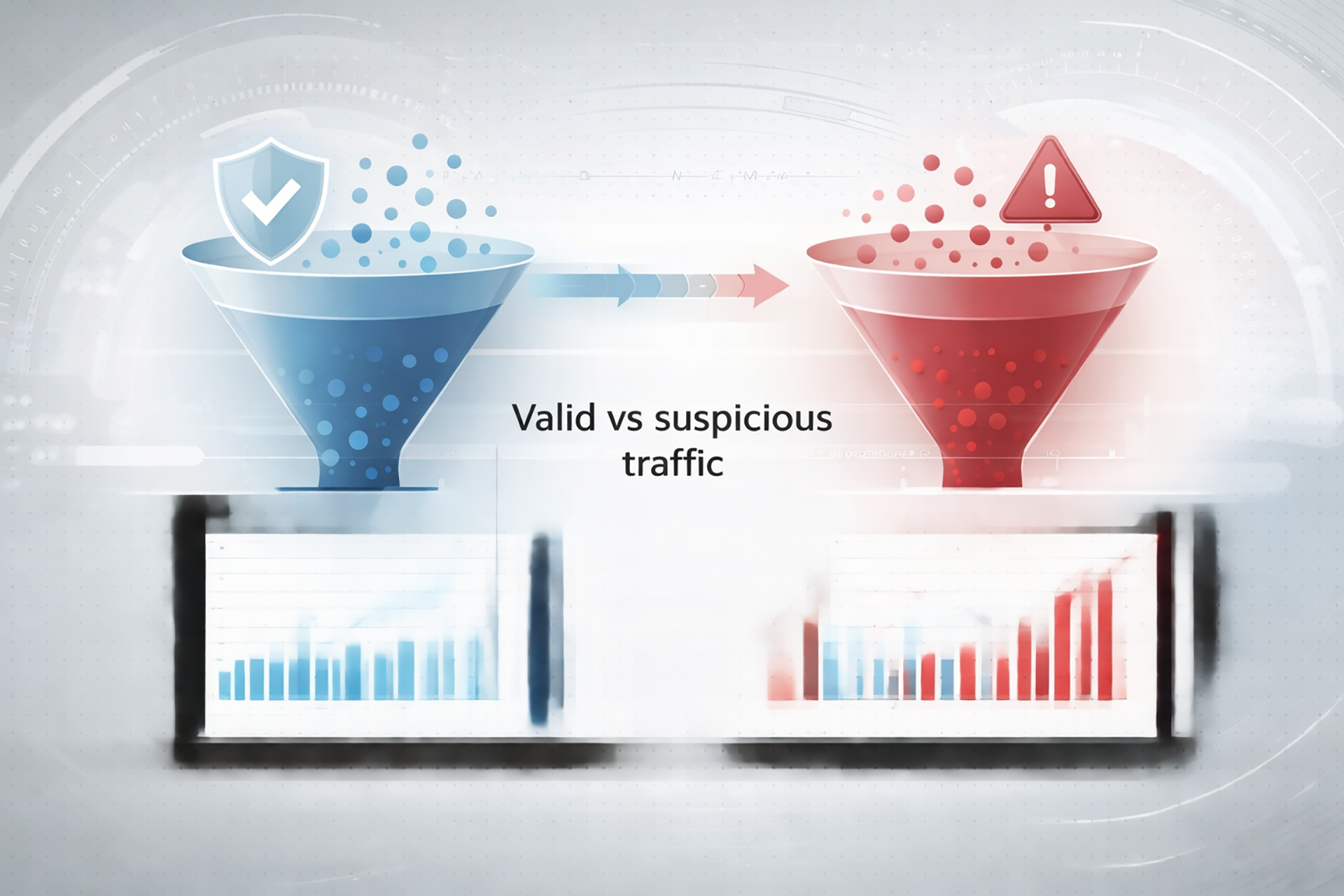
Not every click should be counted equally. Systems should detect and filter suspicious activity before it becomes “billable performance.”
B) IDENTIFY BOT-LIKE BEHAVIOR
Examples of suspicious patterns:
Many clicks in a short time window from the same environment
Repeated clicks with no real browsing behavior
Unnatural device or browser signatures
Odd geography patterns that don’t match your target area
C) PREVENT REPEAT ABUSE
If a single source can click you 20 times a day, you will lose money even if each click looks “valid” in isolation. Good prevention spots repetition and abnormal frequency.
D) PROTECT LEAD FORMS
For lead generation, good prevention includes:
Basic form validation
Abuse controls that reduce automated submissions
Quality scoring or review mechanisms to flag suspicious leads
E) TRANSPARENT REPORTING
You should be able to see, at least at a high level:
What was counted
What was flagged
What was excluded
What patterns triggered protection
If the reporting is a black box, you are relying on hope.
EARLY WARNING SIGNS YOUR CAMPAIGN HAS A TRAFFIC QUALITY PROBLEM
These signs are common in automotive:
Clicks go up, but calls and messages stay flat
Cost per click is “too good,” yet nothing converts
Traffic spikes late at night (especially for local service businesses)
Many leads are uncontactable, duplicated, or nonsense
Very high bounce rates or extremely short visits
Lots of “form submissions” but no meaningful conversations
You see high activity in areas you do not serve
One or two anomalies can happen naturally. A repeated pattern is your signal to investigate.

HOW TO BUY DIGITAL ADS SAFELY (A BUSINESS-FIRST PLAYBOOK)
If you’re a dealer principal, workshop owner, parts manager, or insurance manager, here is the simplest approach that works:
STEP 1: OPTIMISE FOR REAL OUTCOMES (NOT VANITY METRICS)
Define success as:
Connected phone calls
WhatsApp conversations that progress
Booking confirmations
Qualified leads (contactable, local, relevant)
Test drive appointments
Quote-to-sale ratio improvements
STEP 2: SET A “VALID LEAD” STANDARD
For example:
Must have a valid phone number
Must be inside your service radius
Must match your category (tyres, service, parts, insurance)
Must include basic vehicle info when relevant
This immediately reduces the value of fake leads to fraudsters, and it forces your system to focus on quality.
STEP 3: USE TIGHTER TARGETING AT THE START
Many campaigns fail because they start too broad. In automotive, tight relevance beats cheap reach.
Target your real service area
Exclude regions you cannot serve
Focus on the right intent (service booking vs general interest)
STEP 4: ADD GUARDRAILS
Daily caps during testing
Time-of-day scheduling if your conversions are call-based
Frequency caps to prevent over-serving the same user
STEP 5: CLOSE THE LOOP WITH YOUR CRM OR SALES PROCESS
A campaign is not successful because it produced “leads.”
It is successful when it produces:
Contacted leads
Qualified leads
Booked appointments
Sold units / completed jobs / issued policies
Track those outcomes and feed them back into decisions.
QUESTIONS TO ASK ANY DIGITAL AD PROVIDER BEFORE YOU SPEND
Use this checklist in meetings:
How do you detect and prevent invalid clicks and bot traffic?
Do you filter suspicious activity in real time, or only after the fact?
How do you handle repeated clicks from the same sources?
If suspicious traffic is detected, is it excluded from reporting and billing?
For lead generation, what controls exist to reduce fake submissions?
Can you show lead quality metrics, not just lead volume?
Can you segment performance by geography and time-of-day to spot anomalies?
Do you provide transparency on what was flagged or filtered?
How do you optimise toward outcomes like calls, bookings, or qualified leads (not just clicks)?
What is your process when a client reports suspected fraud or poor-quality leads?
If the answers are vague, the risk is yours — not theirs.
A SIMPLE EXPLANATION YOU CAN USE IN YOUR ARTICLE
If you want one clear line that resonates with business owners:
Fraud prevention protects two things: your advertising budget and your decision-making. Without it, you can spend money and still end up with misleading data that pushes you further away from real customers.
CONCLUSION: FRAUD PREVENTION IS NOT OPTIONAL IN AUTOMOTIVE
Automotive advertising is competitive, local, and high value. That makes it powerful when done right — and expensive when done wrong.
Fraud prevention matters because it helps ensure:
You pay for real potential customers, not artificial activity
Your lead pipeline stays clean
Your teams stay motivated and productive
Your reporting remains trustworthy enough to make confident decisions
Your marketing spend can scale without hidden leakage
If you’re considering digital advertising for a dealership, workshop, tyres, parts, or insurance, treat fraud prevention like you treat financial controls: essential, measurable, and non-negotiable.